
Best Programming Language for Kids: How to Choose the Right One
If you’re searching for the best programming languages for kids, chances are you’ve noticed your child spending hours in front of screens without gaining real skills, and you’re wondering how to turn that time into something meaningful. Today, coding is no longer optional; it’s a key future skill that helps children think logically, solve problems creatively, and build real projects instead of just consuming content.
In this complete guide, we’ll help you choose the right kids’ programming language and show how Icon School supports your child step-by-step to start strong and stay motivated.
Why Teaching Programming to Kids Is a Necessity, Not a Luxury
Today, choosing the best programming language for kids is not simply a modern trend; it’s a foundational investment in your child’s future thinking, creativity, and success. Technology is now part of every career path and daily decision, and at Icon School, we help children shift from tech consumers to confident digital creators ready for tomorrow.
Developing Logical Thinking and Creative Problem-Solving
Before diving into results, let’s explore why coding dramatically strengthens children’s minds and learning abilities.
How coding builds sharper thinking and problem-solving abilities:
- Breaking big challenges into small steps, building systematic thinking.
- Enhancing planning, sequencing, and decision-making skills.
- Strengthening creativity by designing stories, characters, and game logic.
- Encouraging perseverance through debugging and testing.
- Boosting performance in math and science through logic-based tasks.
- Supporting memory and focus through coding exercises and structured projects.
- Learning by doing from building animations to creating mini-games.
Preparing Children for the Future Job Market
The future job market demands more than academic grades, it requires digital literacy and problem-solving skills from an early age.
Why learning programming early opens future opportunities:
- Global reports predict strong demand for tech-skilled talent by 2030.
- Coding is becoming a core literacy in every professional field.
- Programming plays a role in medicine, engineering, design, gaming, business, and AI.
- Early exposure helps children discover personal interests and passions.
- Learning the kids’ programming language path now builds career confidence later.
Boosting Self-Confidence and Creativity
Coding doesn’t just build skills, it builds strong character and belief in one’s abilities.
How programming boosts confidence and creative expression:
- Children gain pride when they see their game or story come alive on screen.
- Turns screen time from consumption to meaningful creation.
- Encourages resilience learning that mistakes are part of success.
- Inspires creative storytelling, animation, and interaction design.
- Builds independence and leadership through project-based learning.
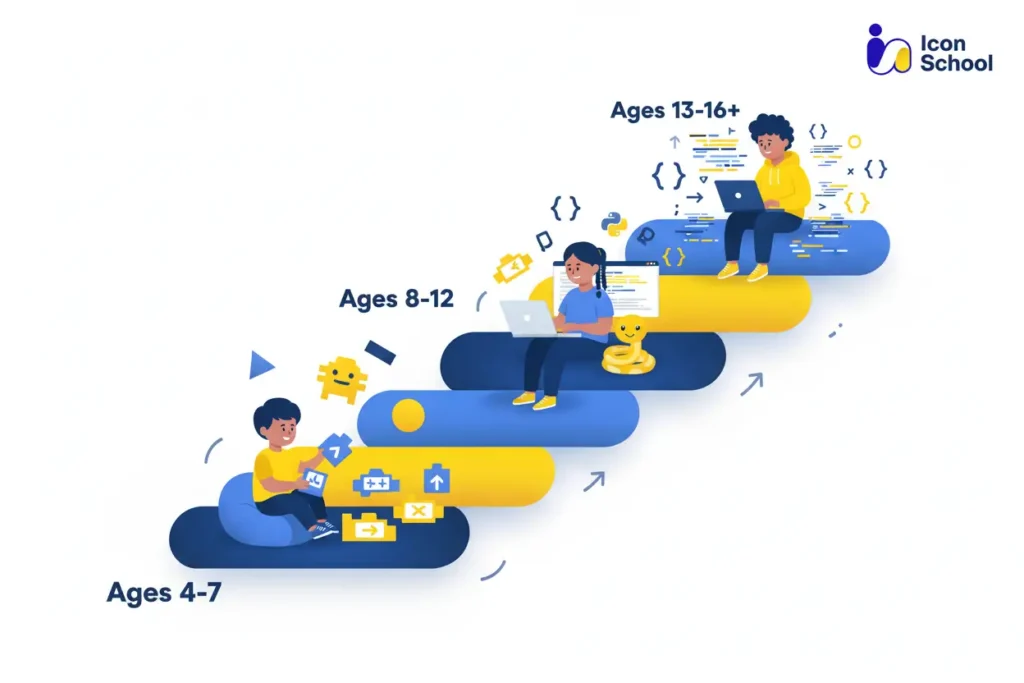
What Are the Best Programming Languages for Kids by Age Group?
Every child learns differently but choosing the best programming language for kids becomes much easier when aligned with age, cognitive development, and learning style.
At Icon School, we follow a progressive pathway that makes learning natural, fun, and confidence-building, ensuring each student moves smoothly from simple visual coding to fully writing real applications.
Visual Programming Languages for Children Ages 4–8
At this early age, children benefit most from intuitive, playful coding environments that avoid syntax complexity and focus on logic and storytelling.
- ScratchJr & Scratch: ScratchJr targets ages 5–7 and Scratch ages 6–8. Both use drag-and-drop blocks, making coding accessible without typing.
- Drag-and-drop concept: Blocks snap together like puzzle pieces, helping children grasp sequencing and logic rather than worrying about errors in syntax.
- Benefits for young learners: No need for typing or memorizing syntax Focus on logical flow, creativity and visual feedback Immediate project results increase motivation.
- Examples of simple projects: Animating a character to move across the screen, Creating an interactive story where sprites respond to taps, Designing a mini-game where the child chooses when things happen.
- Foundational purpose: At this stage, children build confidence, creativity and early computational thinking that supports later transition to text-based code.
Transitioning to Text-Based Languages for Children Ages 9–12
Once children are comfortable with logic and sequence, they begin to benefit from real coding syntax and structured programming environments.
- Python: A recommended first text-based language for kids ages 9–12 because its syntax is clear, close to English, and versatile for games, apps and automation.
- JavaScript: Suitable for children interested in web development or browser-based games; introduces interactive websites and event-driven logic.
- Difference from visual coding: Text-based programming introduces typing, syntax, debugging and error-handling skills that extend beyond visual blocks.
- Project examples: A Python game that asks user input and responds, A JavaScript interactive web page where clicking elements triggers animations, A small application combining logic loops, variables and user input.
- Why this stage matters: The child advances from being a code-player to a code-writer, developing stronger abstraction, logic and readiness for advanced subjects.
Advanced Programming Languages for Teens Ages 13–17
Teenagers are ready to explore professional-style programming, specialise in a domain and build real applications bridging into college and career skillsets.
- Languages & fields: C++/Java: strong logic, object-orientation, robotics and CS fundamentals.
- HTML/CSS + JavaScript: complete web development stack • Lua: ideal for game development especially platforms like Roblox, Mobile development tools (e.g., Swift, Flutter) for app building.
- When to move to this stage: The teen should already be comfortable with text-based programming, debugging, and building small scale projects.
- Importance of specialisation: Choosing a domain (game dev, web dev, AI) helps focus learning, build portfolio and define career direction.
- Real project examples: A fully-featured web app with user login and data display, A mobile game with levels, scoring and graphics, A mod or custom game built using Lua for a platform like Roblox.
- Goal of this stage: Empowering teens to produce work comparable to entry-level developers, helping them become creators rather than just learners.
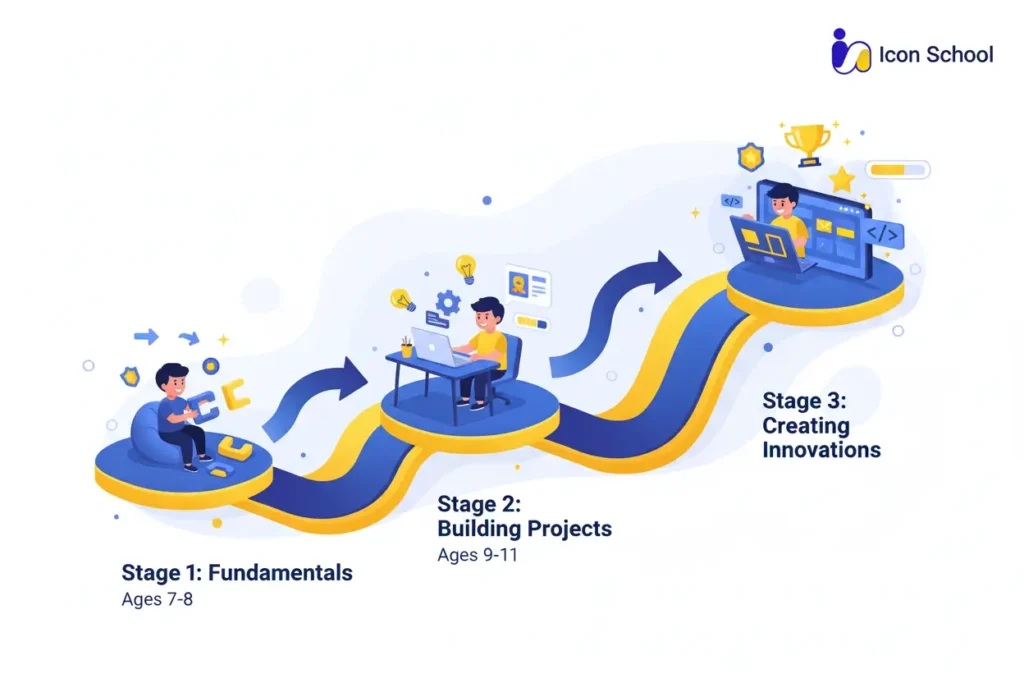
The Best Learning Path: How Kids Progress from Beginner to Programmer
Every parent wants to give their child a skill that actually matters for the future, a skill that builds confidence, intelligence, and opportunities. But coding isn’t learned by chance; it follows a proven learning journey.
In Icon School, we take children step-by-step through a clear pathway designed to turn curiosity into competence and competence into real-world talent.
Stage One: Building Fundamentals (Basic Programming Concepts)
In this stage the focus is on foundational thinking skills rather than mastering any single language.
- Sequencing: Learning to order commands so that instructions make sense, laying the basis for algorithmic thinking.
- Loops & conditions: Introducing repeat actions and decision-making (“if… then… else”) helps children understand program flow.
- Variables: Understanding that values can change and be stored gives children early insight into data handling.
- Fun through games and activities: Children might drag blocks, solve puzzles or control robots, making concepts tangible and engaging.
- Importance of logic first: Before diving into Python or another language, children must internalize how programs ‘think’ and solve problems.
- Duration & mastery: Usually 6-12 months of guided learning and practice until children reliably apply loops, variables and conditions in simple tasks.
- Foundation ensures success: A firm grasp of fundamentals avoids frustration later when syntax and complexity increase.
Stage Two: Practical Application and Building Projects
Once fundamentals are in place, the child moves into project-based learning where real coding brings ideas to life.
- From theory to real code: The child writes actual lines of code moving beyond block logic to typed instructions.
- Age-appropriate projects: For example: a quiz game in Python for 9-12 year-olds, or a small interactive web page using JavaScript.
- Learning by doing: Trial and error, debugging mistakes and improving results give children resilience and real skill.
- Reinforcing concepts: Each project integrates loops, variables, conditions in meaningful contexts strengthening understanding.
- Developing problem-solving muscle: Trying to solve a real task (e.g., make the character jump when clicked) develops planning, debugging and iteration.
- Portfolio beginnings: Children begin to compile a record of increasing complexity, which boosts confidence and shows growth.
Stage Three: Specialization and Professional Development
At the final stage, the young programmer chooses their focus and starts working on advanced, real-world style projects.
- Choosing a specialization: Whether web development, game design, mobile apps or even AI, the teen aligns coding with their passion.
- Importance of interest-driven learning: When the subject matters personally, motivation, creativity and output all increase.
- Advanced projects build portfolios: A teenage coder might build a web app, publish a mobile game or create a data visualization tool all showing real-world readiness.
- From educational to semi-professional work: Projects now include version control, collaboration, design thinking and deployment.
- Career-oriented mindset: The goal shifts from “just learning” to “creating for users or customers”, planting seeds for future careers.
- Transition readiness: By now the child is ready for internships, competitions or open-source contributions, setting them apart earlier.
How to Choose the Right Platform to Teach Your Child Programming
Choosing the right educational platform for your child’s programming journey means matching their learning style, interests, and future goals with a quality institution.
At Icon School, we believe in offering more than just classes, we provide a complete roadmap that blends structured curriculum, live interaction, and community-driven growth, so your child not only learns a programming language but thrives with it.
Criteria for Choosing the Ideal Educational Program
When selecting a coding program for your child, these are the essential criteria to evaluate:
- Curriculum Designed for Kids: Ensure the content is graduated, age-appropriate, and tailored for young learners rather than simplified adult content.
- Live Interactive Sessions with Qualified Teachers: Real-time interaction helps children stay engaged and receive immediate feedback, which is vital for progress.
- Practical Projects and Real-World Applications: Programs should emphasise “learning by doing” building tangible projects that support understanding and skill retention.
- Progress Tracking and Certifications: Look for platforms that provide measurable progress reports and certificates that recognise real achievements, not just attendance.
- Small Classes and Accessible Format: A low student-teacher ratio and flexible access (online or offline) help tailor learning to the child’s pace and schedule.
The Difference Between Self-Learning and Organized Learning
Understanding both options helps you decide what’s best for your child’s stage and temperament.
- Self-Learning Advantages:Offers flexibility and low cost; good for motivated older kids who can drive their own progress.
- Self-Learning Challenges: Lack of guidance, difficulty maintaining consistency, and no evaluation or feedback to ensure real learning.
- Organised Program Benefits: Structured guidance, integrated curriculum, continuous support and assessments keep children engaged and on-track.
- When Each Option Works: Self-learning may suffice for teens who already code and follow online resources; younger children benefit significantly from a guided program with accountability and peer interaction.
Importance of Educational Community and Peer Interaction
A thriving learning community enhances motivation, innovation and growth in ways a solo learner might miss.
- Peer Motivation and Idea Exchange: Group learning lets children share projects, spark ideas and stay inspired by seeing what others create.
- Coding Competitions and Challenges: Healthy competition encourages higher performance, teamwork and deeper engagement beyond basic assignments.
- Accelerated Learning Through Collaboration: Working with others teaches communication, feedback-sharing and real-world project dynamics.
- Feedback from Teachers and Peers: Receiving structured feedback helps children refine their work and see coding as a collaborative craft, not just solo play.
Practical Tips for Parents to Support Kids Learning Programming
Helping your child succeed in programming isn’t about turning your home into a classroom, it’s about creating a supportive ecosystem.
At Icon School, we’ve learned that parental involvement can double a child’s progress when combined with structured learning, encouragement, and the right habits.
These practical strategies help transform curiosity into consistent growth, confidence, and real coding skills.
Creating a Stimulating Learning Environment at Home
Children learn best when they have a consistent routine, a quiet workspace, and freedom to explore ideas without pressure. Parents can support this by:
- Providing a dedicated learning space: A calm corner with a notebook and computer signals that learning time is important and helps children focus.
- Setting a weekly programming schedule: Short, regular sessions build discipline and keep progress steady without overwhelming the child.
- Encouraging sharing and storytelling about projects: When children explain their work, they clarify their thinking and develop confidence in their abilities.
- Allowing space for creativity and mistakes: Programming is experimentation. Let children try, fail, adjust, and try again without pressure or comparison.
- Monitoring progress through available learning reports: Parents can stay involved by reviewing progress notes and performance reports provided by their program (e.g., learning dashboards, teacher feedback reports).
Dealing with Challenges and Frustrations
Coding naturally includes errors and debugging, so learning how to respond to frustration is essential. Parents can help by:
- Normalizing mistakes as part of coding: Remind children that even expert developers debug daily errors are learning tools.
- Teaching problem-solving habits: Encourage breaking tasks into smaller parts, re-reading instructions, and trying multiple approaches.
- Turning setbacks into lessons: Praise effort, persistence, and curiosity rather than just success this builds a growth mindset.
- Recognizing when to rest and when to persist: Support short breaks for clarity; return with fresh focus when energy resets.
- Using teacher support when needed: If the child is enrolled in an academy, encourage asking instructors questions instead of feeling stuck alone.
Celebrating Achievements and Motivating Continuation
Recognition fuels motivation, especially for young learners. Parents can reinforce learning by:
- Celebrating every win — big or small: Completing a lesson, fixing a bug, or finishing a mini-game deserves recognition.
- Creating a digital or physical “project display space”: Pin achievements on a wall or build a digital portfolio to track growth over time.
- Using certificates and rewards meaningfully: Certificates reinforce confidence and help children see progress as real, not abstract.
- Connecting coding with existing interests: Whether a child loves games, art, storytelling, or robotics link projects to what they already enjoy.
- Setting future challenges: Small, structured goals maintain momentum and spark excitement for what’s next
Frequently Asked Questions About Teaching Kids Programming Languages
Is my child too young to learn programming?
No children from about age 4 can begin with visual, block-based tools that teach sequencing and cause-and-effect, Icon School offers age-specific starter tracks (ScratchJr/Scratch) that graduate difficulty gently as skills grow.
How long does my child need to master programming?
Basic programming concepts are typically learned in 3–6 months with regular practice; true mastery depends on age, interest and consistent effort, Icon School’s organized pathways specify milestones and recommended durations so progress is measurable and steady.
Does my child need to be excellent in math to learn programming Languages ?
No beginners learn logic, sequencing and problem-solving first; strong math helps but isn’t required to start, Programming often improves math thinking over time, and Icon School focuses on logic before complex calculations.
What is the expected cost to teach my child programming Languages ?
Costs vary widely: free platforms and tutorials exist, while structured live programs and certified courses come at monthly or term fees, Consider value over price programs with live teachers, projects and progress tracking like Icon School typically deliver faster, more reliable results.
How do I know if my child is enjoying programming Languages ?
Signs include eagerness for sessions, talking about their projects, experimenting outside class time, and wanting to show their work. Try a low-commitment trial or demo class Icon School offers trials to confirm interest without pressure.
What programming opportunities are available in Egypt?
Egyptian families can access local coding clubs, school extracurriculars, national competitions, and international online academies offering Arabic or English tracks. Online programs and hybrid academies make global resources available locally to look for accredited courses, live instruction and project showcases.
In a world driven by technology, giving your child early access to programming is one of the most powerful investments you can make in their future. From building logical thinking to unlocking creative potential and preparing for tomorrow’s careers, every step counts. With Icon School’s guided pathways, expert instructors and hands-on projects, your child can start strong, grow confidently and build real-world skills. Begin their journey today, the future won’t wait.