
Your Complete Guide to Choosing the Best Kids Coding Programs in 2025
Choosing the right coding program for your child can feel overwhelming. With so many options, varying ages, teaching methods, and tools, parents often worry about wasting time, money, or limiting their child’s potential. Many hesitate, unsure which programs truly develop skills versus those that are just fun distractions.
This guide is designed to remove that uncertainty, providing clear insights and practical steps to find the best kids coding programs in 2025, ensuring real growth and future readiness.
Why Have Kids Coding Programs Become a Necessity, Not a Luxury?
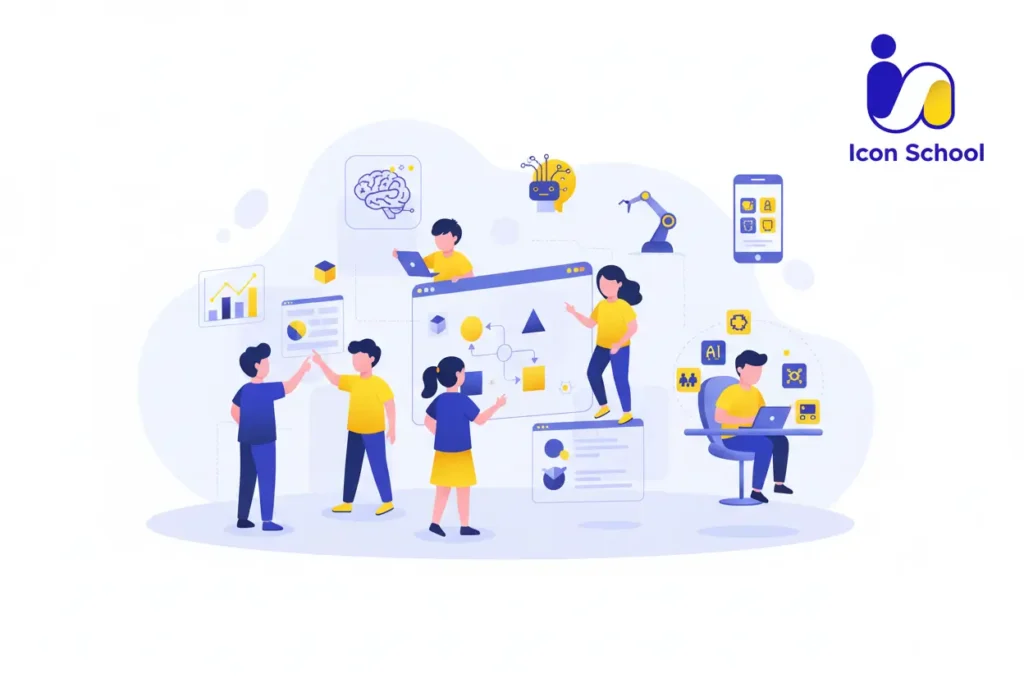
In today’s digital world, coding is no longer optional for children. Parents worry their kids may only consume technology without learning to create, risking missed opportunities for growth. The right kids coding program transforms screen time into skill-building, preparing children for the future while developing critical thinking and problem-solving abilities.
- Future-ready skills: Children enrolled in structured coding programs, such as those offered at Icon School, develop practical programming knowledge in Scratch, Python, or JavaScript. This early exposure equips them for tech-driven careers and competitive academic paths.
- Computational thinking: Coding encourages logical reasoning, pattern recognition, and step-by-step problem-solving, helping children approach real-life and academic challenges with confidence.
- Digital literacy: Beyond basic device use, learning coding helps children understand how technology works, giving them control over digital tools rather than being passive users. This is crucial for long-term digital competence.
- Academic and life benefits: Kids who practice coding show improvements in mathematics, science, and creative subjects. They also gain soft skills like resilience, teamwork, focus, and the ability to debug mistakes constructively.
- Early advantage: Starting coding at ages 4–5 introduces children to computational thinking gradually. Early engagement builds confidence, making future programming concepts easier to grasp and encouraging creativity in project-based learning.
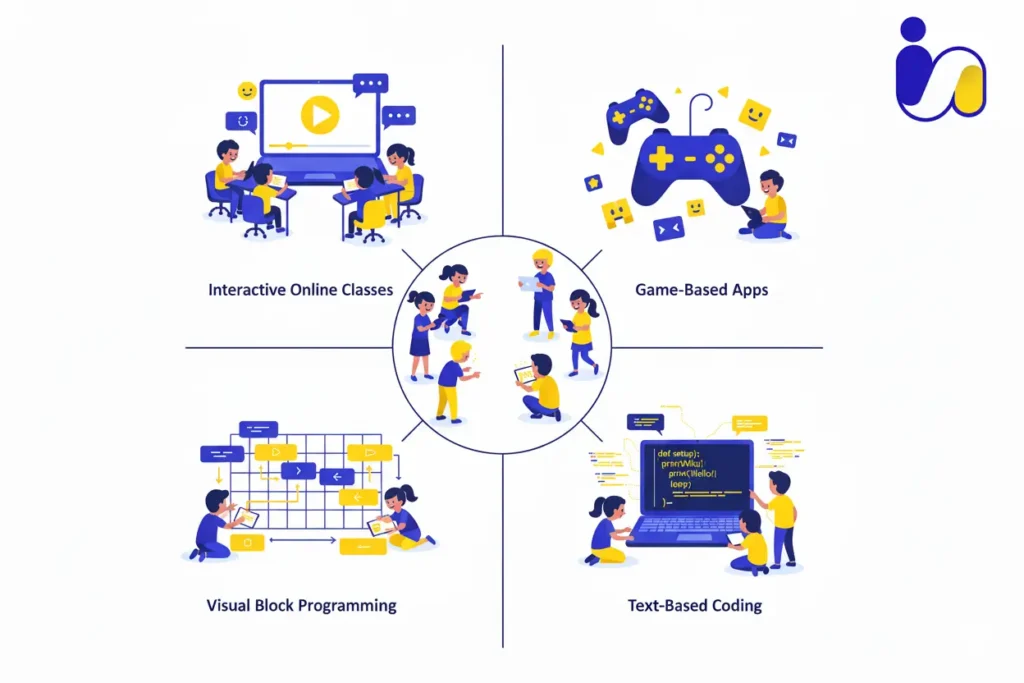
What Types of Kids Coding Programs Are Available?
Choosing the right type of coding program for your child can feel overwhelming, with so many formats, tools, and teaching methods available. Understanding the main categories helps parents select programs that match their child’s age, interests, and learning style, ensuring real skill development instead of just screen-time entertainment.
Interactive Online Educational Platforms
Online educational platforms provide a structured, guided learning environment where children can progress at their own pace while receiving real-time support. These programs combine flexibility, structured lessons, and measurable progress, making them a preferred choice for parents seeking a reliable and comprehensive coding experience for their child.
- Personalized learning paths: Many platforms now use AI to adjust lessons to each child’s pace, ensuring no student feels left behind or bored.
- Live guidance: Real-time classes with instructors allow children to ask questions and receive immediate feedback, increasing engagement.
- Parental oversight: Dashboards let parents track progress, monitor assignments, and understand their child’s skill development.
- Age-appropriate courses: Structured content spans ages 6–15, allowing children to start simple and advance gradually.
- Gradual skill progression: Programs often begin with block-based coding before introducing text-based languages like Python and JavaScript.
- Hands-on projects: Assignments and challenges reinforce concepts and let children see tangible results from their learning.
- Language variety: Exposure to multiple programming languages equips children for diverse future tech opportunities.
- Accessibility: Online access ensures children can learn from home, ideal for Egyptian parents seeking convenience and flexibility.
Game-Based Educational Applications
Game-based coding apps turn learning into interactive fun, motivating children to engage with logic and problem-solving without feeling like they are in a classroom. These programs are especially effective for younger or hesitant learners who might resist traditional instruction but thrive when learning is presented as play.
- Fun and engagement: Coding games present logic and problem-solving within interactive, story-driven gameplay, making learning feel like play.
- Immediate feedback: Children receive guidance on mistakes instantly, helping them understand concepts without frustration.
- Collaboration opportunities: Multiplayer or team-based challenges promote communication and teamwork skills.
- Age suitability: Games are tailored for children 6–14, providing the right challenge without overwhelming beginners.
- Concept reinforcement: Games teach loops, conditionals, and algorithmic thinking in a practical, hands-on way.
- Motivation through rewards: Points, levels, and achievements encourage continuous engagement and perseverance.
- Free and paid options: A variety of programs are available to match different budgets without compromising learning quality.
- Playful introduction to coding: Ideal for hesitant children, these apps lower resistance to starting a coding journey.
Visual Programming Platforms
Visual programming platforms use block-based coding to introduce children to fundamental programming concepts without overwhelming them with syntax. They are perfect for beginners who need a hands-on, interactive environment to understand logic and sequencing before moving to advanced coding.
- Simplified learning: Drag-and-drop blocks remove the frustration of syntax errors, allowing children to focus on logic.
- Computational thinking: Kids develop critical skills in pattern recognition, sequencing, and problem-solving early.
- Beginner-friendly: Platforms like Scratch suit children aged 5–11, providing a gentle introduction to coding.
- Creativity boosters: Some platforms include AR/VR tools to encourage imaginative projects and design thinking.
- Experimentation without risk: Children can try different solutions without fear of failure, reinforcing learning through trial.
- Foundation for text coding: Visual programming prepares students for later learning of real languages like Python or JavaScript.
- Skill integration: Combines coding with storytelling, animation, and logic, making learning multidimensional.
- Educational adoption: Used in introductory courses at Icon School, ensuring structured and pedagogically sound learning.
Coding Courses in Real Languages (Python, JavaScript)
Text-based programming courses focus on real-world coding skills, helping children transition from playful or visual coding to creating actual apps, games, and websites. These programs are crucial for children ready to build practical, future-ready skills.
- Real-world programming: Children learn actual syntax and programming logic, preparing them for practical applications.
- Debugging skills: Courses teach problem-solving in context, helping children identify and fix errors independently.
- Project-based learning: Kids create websites, apps, and games, giving concrete outcomes that demonstrate skill mastery.
- Logical reasoning: Text-based coding enhances structured thinking and a systematic approach to complex problems.
- Creative independence: Students learn to design and execute their own projects, fostering innovation.
- STEM readiness: Prepares children for future education and careers in technology and engineering.
- Progressive skill building: Often follows visual or game-based foundations, allowing a smooth transition to advanced coding.
- Confidence and achievement: Completing real-language projects boosts self-esteem and motivation for continued learning.
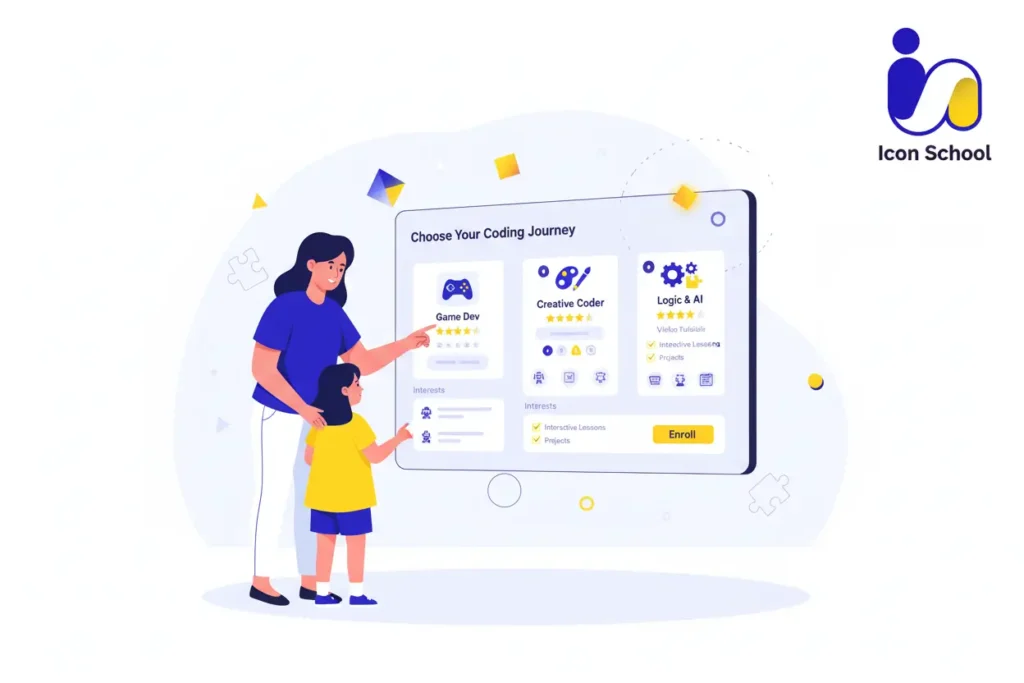
Criteria for Choosing the Right Kids Coding Program for Your Child
Finding the right coding program can be daunting for parents, especially with so many options claiming to teach coding effectively. Choosing wisely ensures that your child not only learns programming but also builds problem-solving skills, logical thinking, and creativity.
Understanding key selection criteria will help you make an informed choice and avoid wasting time or money on ineffective programs.
- Age appropriateness: Ensure the program matches your child’s developmental stage; younger children benefit from visual or game-based platforms, while older kids can handle Python or JavaScript projects.
- Learning methodology: Look for programs that combine interactive lessons, hands-on projects, and games to keep children engaged while reinforcing concepts.
- Structured progression: The best programs offer a clear pathway from beginner-friendly blocks to real programming languages, allowing your child to grow without gaps in skills.
- Skill development focus: Choose a program that prioritizes computational thinking, problem-solving, and creativity over simple screen-time entertainment.
- Parental involvement tools: Dashboards, progress reports, or notifications help you monitor your child’s achievements and stay involved in their learning journey.
- Support and mentorship: Access to instructors or mentors, like those at Icon School, ensures children receive guidance and encouragement, boosting confidence and reducing frustration.
- Practical outcomes: Programs that include project-based learning allow children to create apps, games, or websites, giving tangible results that demonstrate skill mastery.
- Flexibility and accessibility: Online platforms should be easy to access from home, while balancing screen-time limits and scheduling to fit your family’s routine.
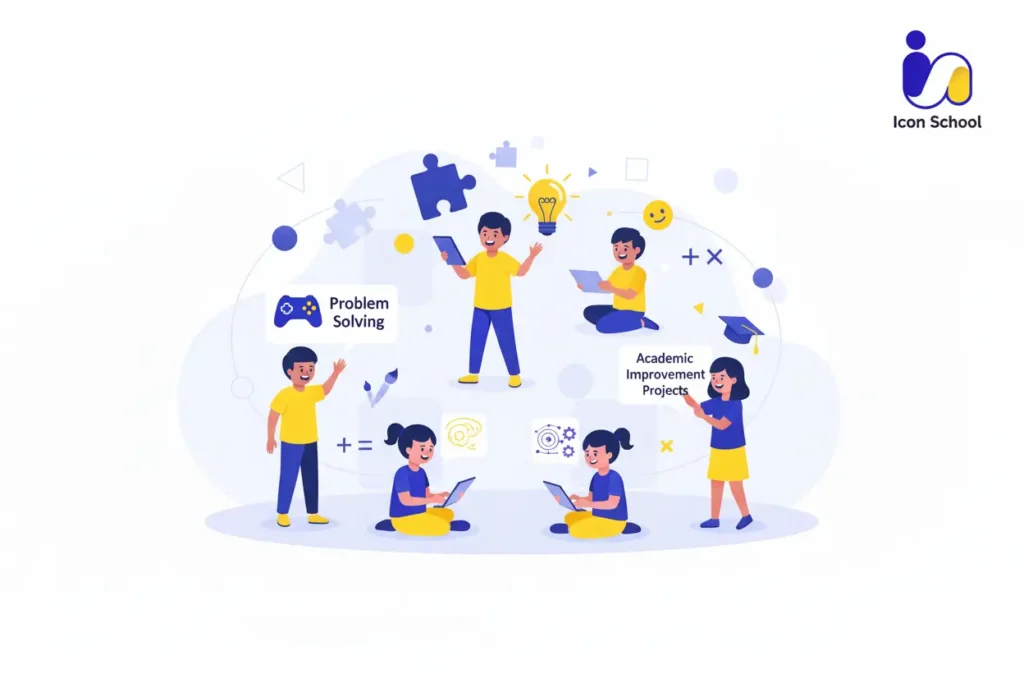
Educational and Personal Benefits of Kids Coding Programs
Introducing your child to a kids coding program unlocks far more than just screen time, it builds a mindset of logic, creativity, and academic strength that will serve them long into the future. Below we explore three pivotal benefit areas that truly justify the investment in such programs.
Developing Logical Thinking and Problem‑Solving Skills
Parents often worry that their children spend hours on games without gaining real challenge but enrolling them in a kids coding program shifts that dynamic.
- Children learn to break down complex problems into manageable steps, developing structured thinking rather than random exploration.
- Coding cultivates algorithmic reasoning, understanding cause and effect, sequencing, and logical flows which directly enhances performance across subjects.
- Debugging and iterating code teach children resilience and perseverance, they learn to approach mistakes as opportunities, not failures.
- The mental habits formed anticipating outcomes, checking for errors, refining solutions carry over into real-life problem-solving, not just coding.
- Studies show early coding exposure boosts computational thinking and procedural skills, which correlate with future cognitive success.
- Children who engage in structured coding demonstrate better organizational skills, prioritizing tasks and working methodically.
- By tackling coding challenges, children gain confidence in handling increasingly complex tasks and develop a mindset geared toward solutions.
- Ultimately, a kids coding program gives your child a toolbox for logical thinking that will help them adapt to a rapidly changing world.
Enhancing Creativity and Innovation
While logic is often emphasized, the creative side of coding is equally crucial especially for Egyptian parents wanting their children to stand out.
- Coding invites children to build games, animations, interactive stories turning imagination into digital reality, fostering innovation.
- Through coding, children explore multiple solutions, experiment with design, and realize there is rarely one “right” answer, boosting creative confidence.
- Using tools like Scratch or Python in a kids coding program allows children to experiment freely with visuals, logic, and outcomes in a creative playground.
- Creativity reinforced in tech encourages children to step beyond consumption to create something highly valuable in today’s digital world.
- Project-based assignments (e.g., build your game or app) give children visible proof of their creative achievement, a key booster for motivation and self-expression.
- As children master coding, they begin to ask “What can I make?” instead of “What can I use?”, shifting from a user to a creator mindset.
- A strong creative mindset complements logical thinking. Nice coding gives children the structure and the canvas at the same time.
- Investing in a kids coding program means nurturing your child’s ability to think both logically and creatively, two skills that differentiate future leaders.
Improving Academic Performance in Mathematics and Science
The final major benefit of a kids coding program is its credible impact on academic performance, especially in STEM subjects.
- Coding strengthens mathematical thinking by using variables, loops, functions, and logical structures, making math concepts more tangible and engaging.
- In science classes, coding’s experimental and simulation-based tasks help children grasp scientific processes and causal relationships better.
- Research shows children who participate in coding programs display higher motivation and stronger achievement in K‑12 STEM curricula.
- Kids learn to test hypotheses, refine variables, and see outcomes—skills that mirror scientific investigation and boost performance in science labs and assignments.
- By engaging in coding, children often develop better focus, attention to detail, and systematic study habits, all of which translate into better grades.
- A kids coding program creates a virtuous cycle: confidence from coding → greater participation in class → improved academic results.
- For Egyptian parents, choosing a trusted kids coding program means not just occupying your child’s time, but enhancing their academic journey and future opportunities.
- When aligned with structured coding courses, children experience measurable progress—not just fun but real academic value.
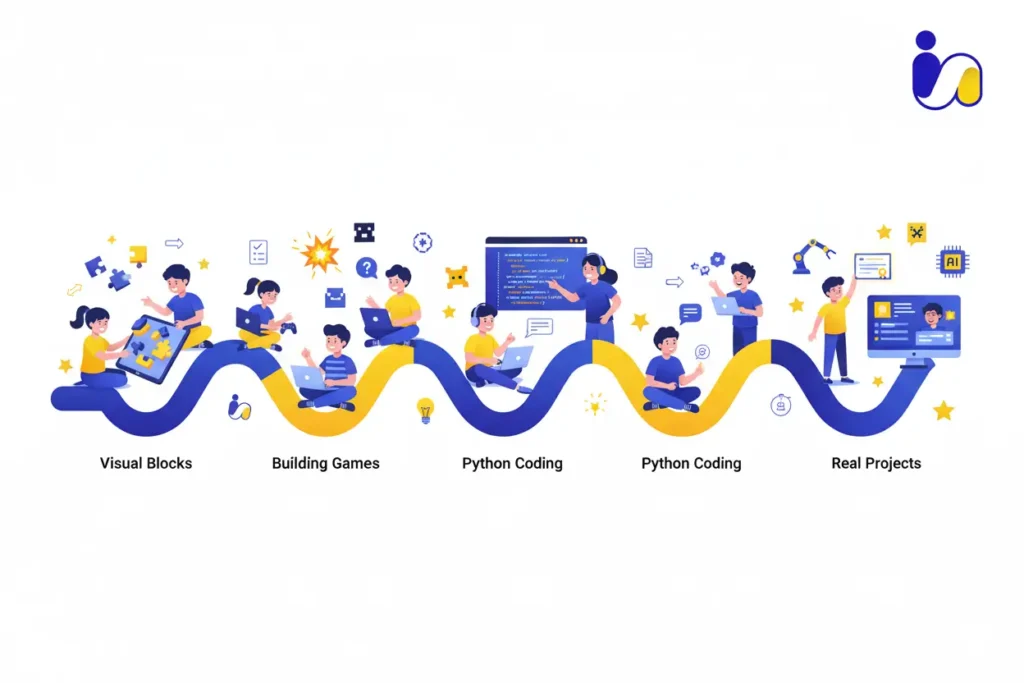
Why Choose Icon School as Your Child’s Educational Partner in Their Coding Journey?
Selecting the right educational partner for your child’s programming journey can feel like navigating a maze: you worry about whether the program aligns with your child’s pace, whether the teaching quality is reliable, and whether you’ll see real results, not just fun.
Icon School addresses these concerns directly, offering a structured, engaging, and future-ready path designed to make your child not just a user of technology, but a creator.
- Age-tailored tracks: Icon School’s curriculum spans children aged 6 to 16, with each level carefully crafted to match the learner’s developmental stage, from Scratch and block-coding for younger children to Python, JavaScript, and AI concepts for older teens.
- Hands-on, project-based learning: Instead of passive lectures, every few weeks your child builds a real project whether it’s a game, a mobile app, or a robot giving visible proof of progress and boosting confidence.
- Flexible delivery (online & in-person): Icon School offers both live online sessions and a physical branch in Dokki, Giza, so families can choose what fits their schedule and environment.
- Clear, measurable progress: Parents get access to dashboards showing attendance, achievements, and next-level readiness so you stay informed and confident about your child’s learning journey.
- Varied tech pathways based on passion: Whether your child is drawn to web development, mobile apps, game design, or robotics, Icon School offers multiple tracks, enabling them to explore and specialize based on what truly inspires them.
- Balance of fun and serious skill-building: The tone is playful and engaging—“learn, build, play, repeat”—but beneath it lies a rigorous structure aimed at developing creativity, computational thinking, and real tech literacy.
- Arabic-friendly, Egyptian-relevant context: For parents in Egypt, the fact that Icon School operates locally and understands the regional context means fewer cultural or logistical surprises and better alignment with your child’s environment.
- Investment in future readiness, not just pastime: Rather than being “another after-school activity,” Icon School positions coding as a tool for your child’s future: new mindsets, digital creation capabilities, and a foundation for STEM paths—all of which relieve the worry that your child is simply consuming tech rather than creating it.
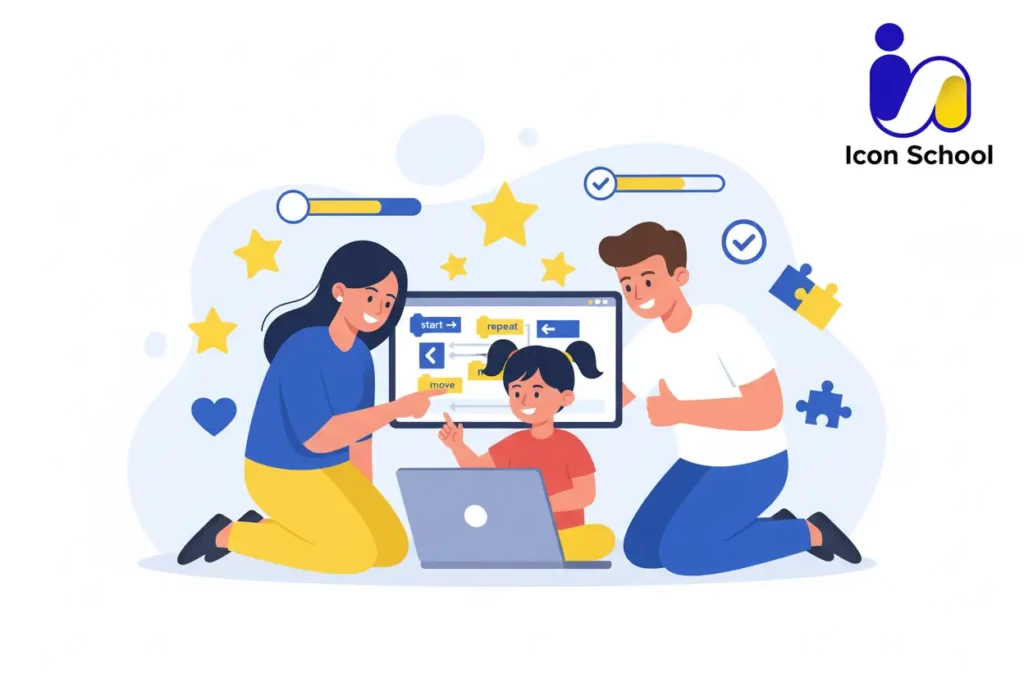
Practical Tips for Parents to Support Their Children’s Coding Journey
Supporting your child in learning coding goes beyond enrolling them in a program. Many parents worry that without proper guidance, screen time can turn into wasted hours or frustration.
By taking small but strategic steps, you can turn coding into a positive, confidence-building, and skill-enhancing experience that truly prepares your child for a digital future.
- Stay involved and engaged: Regularly ask your child about the projects they’re working on, show interest in their creations, and celebrate progress. This reinforces learning and motivates continued effort.
- Create a structured routine: Allocate consistent, manageable coding time each week to build habits, ensuring your child balances learning with other responsibilities and avoids burnout.
- Provide a supportive learning environment: A quiet, well-lit, and distraction-free space allows children to focus and encourages deep problem-solving and creativity.
- Encourage hands-on experimentation: Let children explore their ideas freely without fear of mistakes. Trial and error in coding fosters critical thinking and resilience.
- Connect learning to real-life applications: Relate coding lessons to everyday tasks, apps, or games your child enjoys to make learning tangible and meaningful.
- Celebrate accomplishments, not just completion: Praise creativity, logical thinking, and effort, not only the end result, to nurture intrinsic motivation and a growth mindset.
- Monitor progress using program tools: Platforms like Icon School provide dashboards or reports for parents, making it easier to track skills development and guide your child effectively.
- Encourage collaboration and peer interaction: Learning with friends or participating in coding challenges improves teamwork skills and makes the experience more engaging and social.
- Be patient and flexible: Each child learns at their own pace. Avoid comparisons and focus on progress and continuous improvement to build confidence.
- Integrate cross-disciplinary learning: Encourage your child to combine coding with other interests like math, science, or art, which enhances creativity and practical understanding.
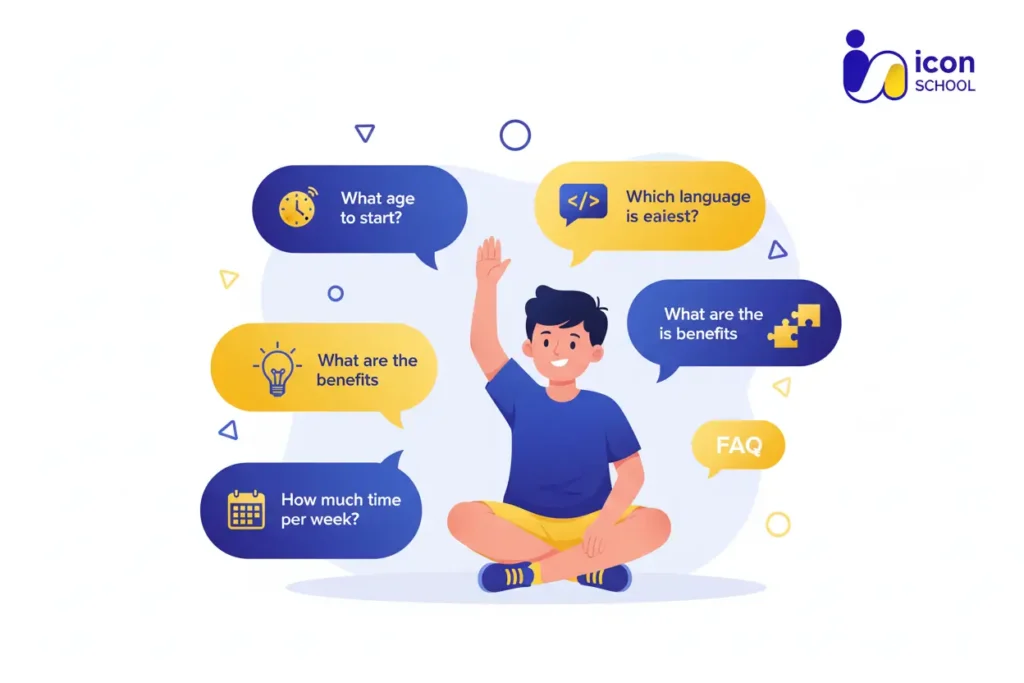
Frequently Asked Questions About Kids Coding Programs
At what age can a child start learning to code?
Children can begin coding as early as 4–5 years using visual programming like Scratch, and from 10–12 years they can start learning actual languages such as Python or JavaScript. Programs like Icon School provide age-appropriate tracks to ensure a smooth progression.
Does coding require advanced mathematical skills?
No, coding does not require advanced math. Basic logic and problem-solving are sufficient, and learning to code actually reinforces and improves mathematical understanding over time.
How much time does a child need to learn coding?
Coding is a continuous journey, but children can start creating simple projects within a few weeks. Regular practice and structured programs, like those offered by Icon School, accelerate progress.
Are free programs sufficient, or should I invest in paid programs?
Free programs are great for beginners to explore concepts, but paid programs provide structured curricula, mentorship, and ongoing support, ensuring your child gains real skills and results.
How do I know if my child is enjoying and benefiting from the program?
Look for enthusiasm, eagerness to share projects, curiosity, and persistence. Positive signs show they are engaged and developing critical thinking, creativity, and coding skills.
Imagine a future where your child doesn’t just use apps, but builds them; doesn’t just play games, but creates them. Coding is more than a skill, it’s a mindset, a superpower for problem-solving, creativity, and innovation. So don’t let hesitation hold them back. Give them the tools to lead in a digital world and start their journey now with Icon School, where imagination meets real coding skills.